
If you've been searching for “hair transplant sedation,” “twilight sleep hair transplant,” or the “Sleep-Deep method,” you likely have one question in the back of your mind: will it hurt? And what exactly am I being given? Online, these terms get used almost interchangeably – and not always correctly – which creates confusion instead of clarity.
This fact check clears things up. We explain, in medically sound terms, what sedation actually means, which active ingredient is used, and how safe the procedure really is – and we cover something most guides leave out: how to sleep on the first night after your procedure so your results heal optimally.
Sedation, Twilight Sleep, and Sleep-Deep: Are They All the Same Thing?
Short answer: yes, with small nuances. “Sedation” and “twilight sleep” are the correct medical terms for the same state – a so-called analgosedation, combining pain relief with deep relaxation. “Sleep-Deep” is the name we use at Phoenix Hair Transplant for our sedation protocol, specifically tailored to hair transplantation. The medical core is identical; the name simply describes how we implement that standard in-house.
What Exactly Is Sedation During a Hair Transplant?
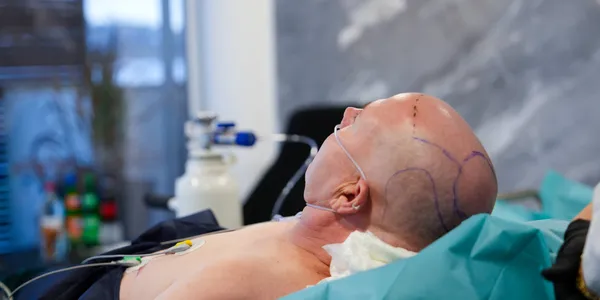
Sedation during a hair transplant is an intravenous, medically supervised form of relaxation that brings you into a calm, twilight-like state before the local anesthetic is administered. You're not fully conscious during this time, but you breathe on your own and wake up again shortly after the procedure. Unlike general anesthesia, sedation places far less strain on your circulatory system.
Sedation vs. General Anesthesia vs. Local Anesthesia Alone: A Direct Comparison
To make the differences easy to grasp at a glance, we've compared the three common approaches used for outpatient procedures like hair transplants:
At Phoenix Hair Transplant, no hair transplant is ever performed under general anesthesia – it isn't medically necessary for this minimally invasive procedure and would carry disproportionate risk. Our Sleep-Deep protocol combines the benefits of sedation with precise local anesthesia in the treatment area.
Do You Get General Anesthesia for a Hair Transplant? The Most Important Clarification
No. A hair transplant does not require general anesthesia. For an outpatient procedure lasting several hours, general anesthesia would not be medically justified and would carry unnecessary risk to the cardiovascular and respiratory systems. Reputable clinics rely exclusively on sedation combined with local anesthesia for hair transplants, even where marketing copy sometimes loosely implies “anesthesia.”
Which Active Ingredient Is Used in Sleep-Deep Sedation?
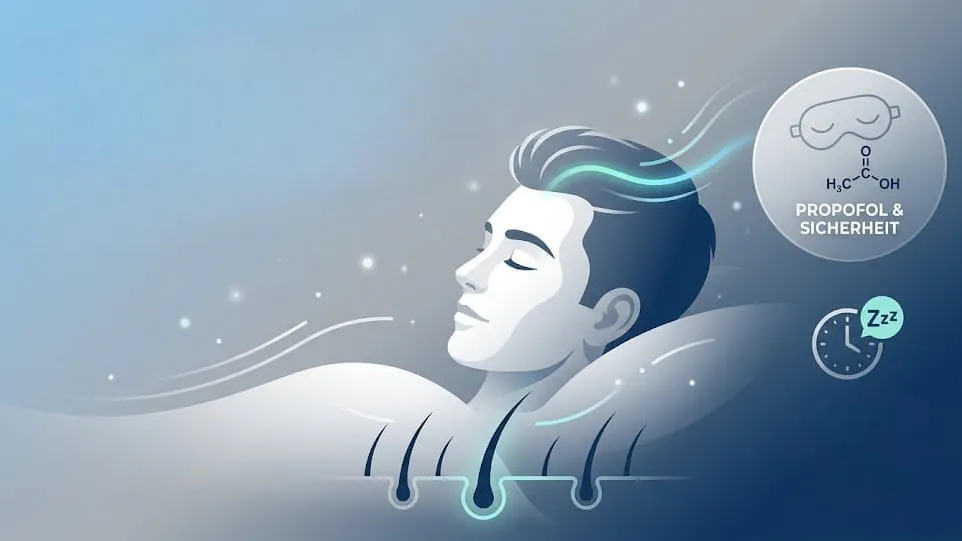
The most commonly used active ingredient for sedation in outpatient procedures is propofol – a short-acting intravenous sedative that has been one of the most extensively studied substances in anesthesiology for decades. Propofol takes effect within seconds, can be precisely controlled, and is broken down by the body very quickly. These exact properties make it the substance of choice for short, well-controlled sedations like those used in hair transplantation.
In Germany, propofol may only be administered by a licensed specialist in anesthesiology – a legal requirement, and standard practice at Phoenix Hair Transplant as a matter of course. Depending on individual tolerance, low-dose supplementary anti-anxiety or pain-relief medication may be added, which your anesthesiologist will discuss with you beforehand.
Is Propofol Safe? Common Concerns, Fact-Checked
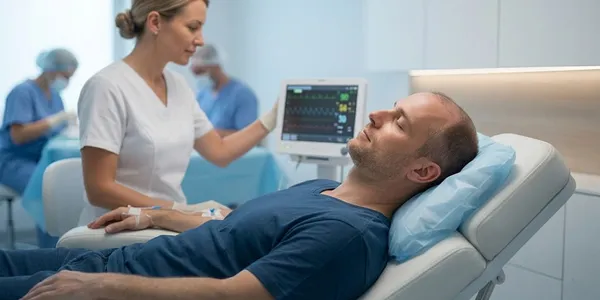
Propofol is one of the most thoroughly researched sedatives in modern medicine and is used millions of times worldwide for outpatient procedures. Well-known cases reported in the media almost always involved improper use outside a controlled clinical setting – for example, without medical supervision or continuous monitoring. Under the conditions in place at Phoenix Hair Transplant – individually calculated dosing, continuous monitoring of pulse, oxygen saturation, and blood pressure, and the constant presence of a specialist physician – the risk associated with propofol sedation is considered very low.
Can Every Patient Be Sedated During a Hair Transplant?
The vast majority of our patients are suitable candidates for Sleep-Deep sedation – but there's no blanket medical “yes.” Certain pre-existing conditions, such as severe cardiovascular or respiratory disease, or specific medication intolerances, require an individual risk assessment. That's why our anesthesiologist always clarifies your suitability in a personal consultation before sedation is scheduled.
What's the Best Way to Sleep the First Night After a Hair Transplant?
Direct answer: on your back, with your head slightly elevated – and ideally no contact between your pillow and the transplanted area. This sleep position protects the freshly transplanted grafts from pressure, friction, and accidental dislodging during the most sensitive phase of healing.
- Sleep on your back and keep your head elevated by roughly 30–45 degrees using several pillows or a travel pillow.
- Use an inflatable neck or travel pillow so the back of your head has no direct contact with your regular pillow.
- Avoid any touching, rubbing, or scratching of the transplanted area – even unconsciously while asleep.
- Keep this sleep position consistently for at least 5 to 7 nights, even if it feels unfamiliar at first.
- Take advantage of sedation's lingering calming effect: many patients report sleeping especially still and restfully on the very first night.
Checklist: How to Recognize Genuinely Safe Sedation
Not every clinic that advertises “twilight sleep” or “Sleep-Deep” meets the same medical standards. These five points should be non-negotiable:
- A personal consultation with the anesthesiologist takes place before sedation – not just in the treatment room right beforehand.
- The attending anesthesiologist is a licensed specialist practicing in Germany, named and available to speak with you directly.
- Pulse, oxygen saturation, and blood pressure are continuously monitored and documented throughout the entire sedation.
- Fasting requirements before the procedure are actively confirmed with you, not left to chance.
- Full emergency equipment is available on-site, even though it's rarely needed.
Quick Answers: More Common Questions
How Long Does the Sedation Last in Total?
Sedation typically lasts as long as the procedure itself – between four and eight hours, depending on the number of grafts. Your anesthesiologist continuously adjusts the dosage throughout, keeping you in that relaxed, twilight state the entire time.
Does Sedation Add Extra Cost?
At Phoenix Hair Transplant, Sleep-Deep sedation is a fixed part of the treatment package and is communicated transparently in advance – no hidden costs on the day of your procedure. For a detailed breakdown of hair transplant pricing in Germany, see our separate cost guide.
Does Sedation Affect Every Patient the Same Way?
No, the effect varies from person to person and depends on factors like body weight, age, metabolism, and individual sensitivity. That's why dosing is never one-size-fits-all – it's calculated individually for each patient and continuously monitored and adjusted throughout the procedure.
Conclusion: Informed Confidence Instead of Uncertainty
Sedation, twilight sleep, and Sleep-Deep all describe, at their core, the same proven medical standard: a gentle, medically supervised alternative to general anesthesia that makes your hair transplant completely pain-free. What matters isn't the name – it's the medical quality behind it: approved active ingredients, a specialist anesthesiologist, and uninterrupted monitoring.
Want to know if Sleep-Deep sedation is right for you? Book a free, no-obligation consultation with our team – we'll answer all your questions personally, transparently, and without any pressure.